
Which floor covering to choose when you have a pet
If you are renovating and you have a pet at home, or you are planning to get one, it is worth choosing the floor covering more carefully. What matters is not only how it behaves in use, but also how safe and comfortable it will be for your pet.
Let us look at the pros and cons of popular floor coverings.
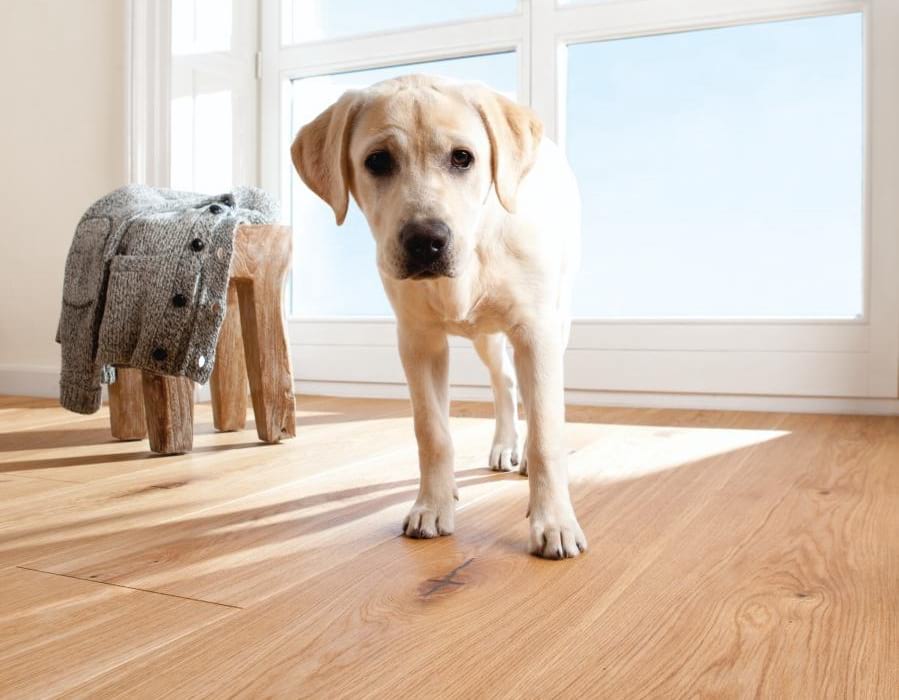
Engineered wood flooring
- Natural material — the main advantage. Natural wood is good both for you and for your pets, since they practically “live” on the floor and often spend more time at home than you do.
- Warmth — wood is a warm, comfortable surface even without underfloor heating.
- Repair — the simplest and quickest option is to replace a single glued-down board.
- Acoustic comfort — you will not hear claws clicking across the floor.
- Sensitive to moisture — oiled parquet most of all, because its pores are open and moisture is absorbed quickly.
- The surface is not scratch resistant.
- Requires constant, intensive care — to keep the floor looking good, be ready to look after it: remove small scratches and treat it roughly every six months with special products for oiled and lacquered floors.
To keep parquet from being slippery, choose a floor with a textured surface — brushed, finished with oil or matt lacquer. Scratches are also less visible on brushed, light-toned boards.
Vinyl flooring (LVT)
- Moisture resistant — 100% resistant to moisture and odours.
- Warm — vinyl conducts heat poorly, so it does not let the cold through from the subfloor and stays warm.
- Not slippery.
- Easy to repair — a damaged plank can be replaced whether it was glued down or laid floating.
- Quiet.
- Easy to care for — ordinary dry or damp cleaning, with no special products or procedures needed.
The surface of vinyl flooring is not as scratch resistant as tiles, but it is resistant enough. We are happy to provide a sample of the material so that you can test its scratch resistance yourself.
Ceramic tiles
- Not affected by moisture.
- Scratch resistant.
- Cannot be repaired, and a section of the floor cannot be replaced if it is damaged.
- Cold, although underfloor heating can be installed.
- Slippery, especially when wet. But tiles with a non-slip surface are available.
Not bad overall, though tiles are not the best option for a bedroom or a children's room.
Laminate
- Repairable, but since laminate is usually laid floating, replacing one plank means moving all the furniture out of the room, taking the floor apart and laying it again — a fairly tiring process.
- Sensitive to moisture.
- Noisy — compared with other floor coverings, laminate is the loudest.
- Slippery, though versions with a special non-slip surface do exist.
Laminate is warmer than tiles but colder than vinyl flooring or engineered wood.
Carpet, in our view, is not suitable for homes with pets. So we are not reviewing it in detail.
We did not manage to find the perfect floor covering, but each one has its pros and cons. To make it easier to choose, we have prepared a comparison table.
| Parquet | Vinyl | Tiles | Laminate | |
|---|---|---|---|---|
| Natural / eco-friendly | ||||
| Moisture resistance | ||||
| Scratch resistance | ||||
| Warm surface | ||||
| Non-slip surface | ||||
| Repair | ||||
| Acoustic comfort | ||||
| Care |
| Natural / eco-friendly | Moisture resistance | Scratch resistance | Warm surface | Non-slip surface | Repair | Acoustic comfort | Care | |
|---|---|---|---|---|---|---|---|---|
| Parquet | ||||||||
| Vinyl | ||||||||
| Tiles | ||||||||
| Laminate |
Look, compare and decide which properties of a floor covering matter most to you.
Please note that this article is based on our own experience and knowledge, which we are sharing with you. It is our point of view, and it may differ from yours or from someone else's. We are not imposing our opinion — the choice is yours.
If you have any questions, we will be glad to answer them!


