
Linoleum flooring for schools: requirements, certificates and specification
School flooring is selected for long-term use, so its price and appearance are not the only factors that should be considered. Resistance to intensive traffic, safety, indoor air emissions, maintenance costs, acoustic performance and the availability of supporting technical documentation are equally important.
In public schools, flooring is often purchased through a public procurement procedure or as part of a construction contract. In such cases, the technical specification must ensure fair competition and allow suppliers to offer equivalent products.
The Marmoleum performance data presented on this page may be used as an informative basis when preparing a project or technical specification. They should not be transferred automatically into public procurement documents without assessing the project’s actual needs, proportionality and the possibility of accepting equivalent solutions.
☘ Basic requirements for school flooring
In Lithuania, hygiene standard HN 21:2017 (clause 45) requires flooring in school premises to be:
- slip resistant;
- even (presenting no trip and fall risk);
- easy to clean using wet cleaning methods;
- resistant to cleaning products.
The suitability of flooring for a school should therefore be assessed using a combination of technical, hygienic and operational characteristics rather than a single certificate.
Additional requirements apply to particular areas. The same clause 45 requires the walls and floors of toilets and showers to be covered with a material resistant to moisture and disinfectants, and clause 46 requires changes in floor level to be marked with warning signs or a contrasting colour – which can be solved with the flooring itself by inlaying a contrasting strip. Entrances, canteens, sanitary facilities, laboratories, stairways and sports halls require flooring selected according to their specific purpose and risks.
☘ Technical performance of 2.5 mm Marmoleum
| Characteristic | Test standard | 2.5 mm Marmoleum |
| Use classification | EN ISO 10874 | 23 / 34 / 43 |
| Reaction to fire | EN 13501-1 | Cfl-s1 |
| Ramp slip resistance | DIN EN 16165, Annex B | R9 |
| Dynamic coefficient of friction | EN 13893 | μ ≥ 0.30 |
| TVOC emissions after 28 days | EN 16516 | ≤ 0.01 mg/m³ |
| Body voltage | EN 1815 | ≤ 2.0 kV |
| Residual indentation | EN ISO 24343-1 | ≤ 0.15 mm (typical ~0.08 mm) |
| Resistance to castor chairs | ISO 4918 | Suitable for continuous use |
| Thermal conductivity | EN 12524 | 0.17 W/mK |
| Impact sound reduction | EN ISO 717-2 | up to 5 dB |
| CE marking | EN 14041 | DoP 0100201-DoP-107 |
| Roll dimensions | EN ISO 24341 | 2 m wide, up to 33 m long |
These figures must be checked against the documentation for the specific Marmoleum collection, thickness and construction. Not all Marmoleum versions have the same use classification, acoustic performance or fire classification. Together with our quotation we provide the technical specification, Declaration of Performance, emission certificates, EPD and installation and maintenance instructions.
Key documents available now: EPD · Marmoleum Soul 05/2026 · Indoor Air Comfort Gold · Der Blaue Engel · Allergy UK
☘ Why is natural linoleum frequently selected for schools?
Low indoor air emissions
Students and teachers spend many hours in classrooms, making the indoor emissions of finishing materials an important consideration.
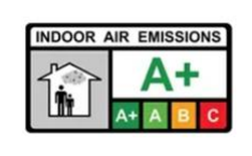
Standard 2.5 mm Marmoleum has a TVOC emission value of ≤ 0.01 mg/m³ after 28 days according to EN 16516. Individual collections may also carry M1, French A+ and Eurofins Indoor Air Comfort Gold emission classifications or certificates.
M1 is a Finnish classification system for low-emission building materials. French A+ and Indoor Air Comfort Gold are separate emission assessment systems and should not be presented as part of a single EN 16516 test result. Before a certificate is included in a project or procurement specification, it should be confirmed that it applies to the proposed collection and product thickness.
Natural composition without PVC or plasticisers
Marmoleum is made primarily from natural raw materials, including linseed oil, wood flour, rosin, limestone and jute. Depending on the collection, the proportion of natural raw materials may reach 97–99%. It contains no PVC, phthalates, plasticisers, PET or synthetic rubber.
Plasticisers are used in flexible PVC flooring, although modern products do not necessarily contain phthalate-based plasticisers. Product comparisons should therefore be based on the specific composition declaration, emission test results, intended use and maintenance requirements.
Straightforward daily maintenance
Marmoleum has a factory-applied Topshield pro surface finish. The floor does not require an initial wax or polymer coating before it is put into use.
Routine maintenance generally involves dry cleaning and the use of a neutral floor cleaner. Cleaning frequency should be determined according to the amount of traffic, level of soiling, required appearance and the school’s hygiene plan.
Topshield pro improves resistance to stains, scratches and dirt build-up. Nevertheless, spillages should be removed as soon as possible. Strongly alkaline or abrasive cleaning products that could damage the surface should not be used.
Maintenance can represent a significant proportion of a floor’s total cost of ownership. Quotations should therefore be compared not only on initial price but also on expected cleaning, periodic maintenance, repair and replacement costs.
Natural bacteriostatic properties
Marmoleum has natural bacteriostatic properties. Independent laboratory testing confirms that its surface inhibits the growth of certain bacteria, including MRSA. These properties are inherent in the material, but they do not replace regular cleaning, disinfection where necessary, or the school’s hygiene plan.
Resistance to intensive use
Standard 2.5 mm Marmoleum meets commercial use class 34 and light industrial use class 43 according to EN ISO 10874. Its residual indentation is ≤ 0.15 mm, and it passes the test for continuous use with castor chairs according to ISO 4918.
These results do not guarantee that furniture will never leave marks. Suitable protective feet should be installed under tables, chairs, cabinets and other equipment, and furniture castors must be suitable for use on resilient flooring.
When installed on a correctly prepared subfloor and maintained in accordance with the manufacturer’s recommendations, Marmoleum can remain in service in schools for decades.
Environmental documentation
Marmoleum is covered by third-party verified Environmental Product Declarations, which describe the product’s environmental impact at different stages of its life cycle.
Marmoleum may also contribute to projects assessed under LEED, BREEAM, DGNB and WELL. The product does not automatically provide a fixed number of credits – the final contribution depends on the selected assessment system, its version and the overall building design.
☘ Acoustics in classrooms and corridors
Standard 2.5 mm Marmoleum provides an impact sound reduction of up to 5 dB. This figure relates to impact noise transmitted through the floor structure and does not describe the room’s overall acoustic performance.
Where a higher reduction in impact noise from footsteps and moving furniture is required, 3.5 mm Marmoleum Decibel may be considered. It provides an impact sound reduction of 18 dB.
Marmoleum Decibel is a separate product:
- total thickness 3.5 mm;
- use classes per the manufacturer’s product information: 23 / 34 / 41;
- some technical properties differ from standard 2.5 mm Marmoleum;
- it is normally ordered in full rolls, so availability, minimum quantity and lead time must be checked separately before it is written into a project.
Impact sound reduction does not replace a complete acoustic design. Music rooms, assembly halls and other acoustically sensitive spaces also require an assessment of sound absorption, reverberation time, wall and ceiling finishes and the sound insulation of partitions.
☘ What should be considered before installation?
Subfloor preparation
Sheet flooring highlights irregularities in the subfloor. The subfloor must be smooth, sound, clean and permanently dry, so its condition should be assessed during the design and budgeting stage. If sanding, priming, moisture protection or levelling is required, these works should be included in the initial cost estimate.
Adhesives
A low-emission adhesive intended for linoleum should be used in accordance with the instructions of both the flooring and adhesive manufacturers. One possible solution is Forbo Eurocol 616 Eurostar Lino Green: EMICODE EC1 PLUS emission class, partly plant-based raw materials. The specific adhesive must nevertheless be selected according to the subfloor, site conditions and flooring construction.
Work scheduling
The flooring has very low volatile organic compound emissions, but this does not mean that school premises can be used immediately after installation. The programme of work must allow for:
- removal of the existing flooring;
- preparation and drying of the subfloor;
- curing of the adhesive;
- noise and dust;
- ventilation of the rooms;
- protection of the new floor against heavy traffic and high point loads.
Forbo’s installation guidance recommends protecting newly installed flooring against heavy traffic and high point loads for approximately 72 hours. The installer should confirm the exact time when the room may be returned to use, taking account of the adhesive instructions and site conditions.
Seams
Marmoleum sheet is supplied in rolls 2 metres wide and up to 33 metres long, and careful layout planning can minimise the number of seams. Depending on the room and project hygiene requirements, seams may be professionally installed as close-fit seams or heat welded using the appropriate Marmoweld welding rod. Heat welding is not required in every room – the decision should be based on the room’s intended use, cleaning method and project requirements.
Underfloor heating
Marmoleum may be installed over underfloor heating. During use, the surface temperature of the subfloor must not exceed 27 °C. The temperature conditions specified by the flooring and adhesive manufacturers must be maintained before, during and after installation.
Delivery and minimum order quantity
For standard 2.5 mm Marmoleum collections the minimum order is 50 m² and delivery takes approximately 14 days from order confirmation. Specialist products such as Marmoleum Decibel, Marmoleum FR and Marmoleum Sport may have different lead times and minimum order quantities; this information is confirmed in the individual quotation.
☘ Documents for design and procurement
Depending on the selected product, we can provide:
- the product’s technical specification;
- the Declaration of Performance;
- reaction-to-fire classification;
- emission test results and certificates;
- the Environmental Product Declaration;
- installation instructions;
- cleaning and maintenance instructions;
- information about the recommended adhesive;
- light reflectance and colour data;
- product samples.
If Marmoleum or another specific brand is mentioned in public procurement documents, the applicable public procurement rules must be considered and the wording “or equivalent” used where required. Technical requirements should preferably be written around the functional and performance characteristics necessary for the project rather than around a single manufacturer’s product.




☘ Frequently asked questions
Does Marmoleum meet the fire requirements applicable to schools?
Standard 2.5 mm Marmoleum has a reaction-to-fire classification of Cfl-s1 according to EN 13501-1. The actual requirement depends on the building, room type, escape routes and the project’s fire safety design, and final suitability must be confirmed by the designer or fire safety specialist. Where a higher classification is required, the specialist Marmoleum FR version may be considered (Bfl-s1, intended for corridors, stairs and escape routes); its availability and technical performance should be checked separately.
How is natural linoleum different from PVC flooring?
Marmoleum is a natural linoleum made primarily from linseed oil, wood flour, rosin, limestone and jute, and contains no PVC or plasticisers. PVC flooring is a synthetic product; plasticisers are used in flexible PVC floors, although modern products do not necessarily contain phthalate-based plasticisers. Both categories have appropriate applications – the decision should be based on emissions, use classification, slip resistance, acoustic performance, maintenance, repairability, price and the intended use of the room.
Is standard Marmoleum suitable for a sports hall?
Standard 2.5 mm Marmoleum is not, by itself, a sports flooring system. A sports hall requires a complete floor construction that meets EN 14904; specialist Marmoleum Sport may be used as the upper layer of an appropriate resilient sports flooring system. The performance of a sports floor depends on the complete construction, including the resilient subfloor.
Can samples and a preliminary estimate be provided before procurement begins?
Yes. We can provide colour samples, technical documentation and a preliminary estimate based on the floor area, intended use and condition of the subfloor. For a public procurement procedure, our information should be treated as market-consultation or reference material, with equal access ensured for all potential suppliers.
Can Marmoleum be recycled?
Marmoleum production waste and clean installation offcuts can be recycled, and in some markets Forbo operates its Back to the Floor collection programme. The possibility of returning installation offcuts or used flooring depends on the country, cleanliness and quantity of the material, logistics and the specific project. Availability of the programme in Lithuania should be confirmed before this requirement is included in project or procurement documents.
Related: Flooring for a kindergarten · Marmoleum eco-labels explained
The technical data are based on official Forbo specifications for 2.5 mm Marmoleum sheet and the Marmoleum Soul technical specification dated 05/2026. The Marmoleum Soul EPD is valid until 23 March 2031. Performance data, certificate validity, lead time and installation requirements for the selected collection will be verified when the quotation is prepared.