
Herringbone parquet: English or French? Types, prices and installation
Herringbone has been back in fashion for several years, but before buying it, most people face the same question: what is the difference between English and French herringbone, and why is the latter more expensive? We explain the differences, prices and something even more important than the pattern itself – the requirements for the subfloor and installation.
English herringbone: the classic straight-cut pattern
English herringbone uses rectangular planks with straight ends, laid at a 90° angle to one another. This creates the characteristic stepped zigzag pattern. It is the traditional version seen in old Vilnius apartments and European museums.
From a practical point of view, all the planks are identical, with no separate left- and right-hand pieces. This means less installation waste and a lower price than chevron. It also offers the widest selection in our catalogue: 101 models from €45/m², mainly from BOEN and ME Floor.
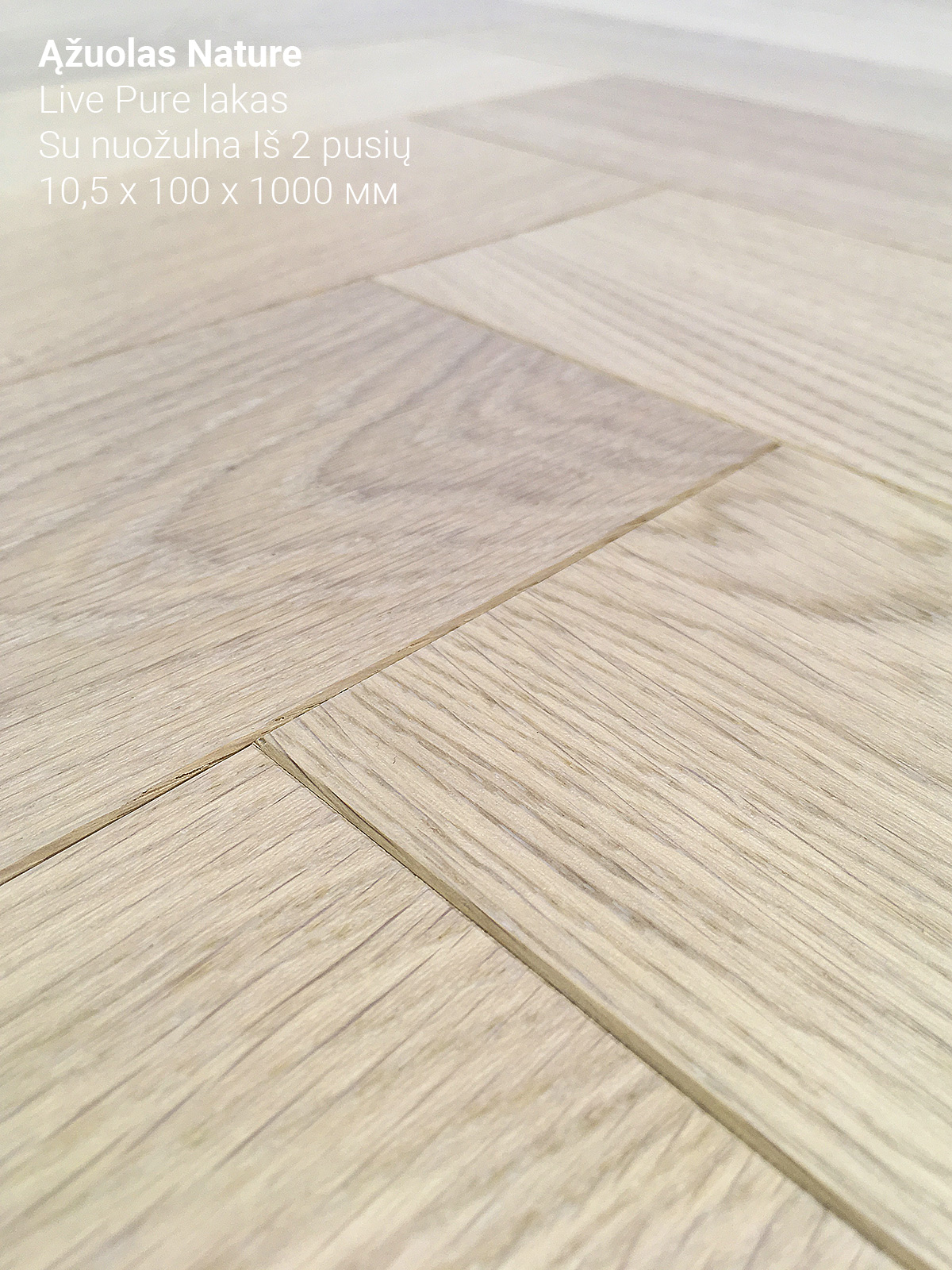
English herringbone: straight plank ends, 90° joints, stepped zigzag
French herringbone (chevron): angled cuts and a continuous V-shaped joint
With French herringbone, the ends of the planks are cut at an angle, usually 45° or 60°. When installed, they meet in a continuous line, creating a clean arrow-shaped pattern without the stepped effect of traditional herringbone.
The result looks more formal and premium, but the higher price is not simply a matter of appearance. Manufacturing is more complex, the planks are divided into left- and right-hand pieces, and installation produces more offcuts.
This is reflected in the price: 22 models from €87/m², meaning the starting price is almost twice that of English herringbone. Chevron is worth choosing when the continuous V-shaped joint is an important part of the design and the budget allows for it.

French herringbone: plank ends cut at an angle, pattern without a step
Comparison table
| English herringbone | French herringbone (chevron) | |
|---|---|---|
| Plank ends | straight (90°) | angle-cut (45/60°) |
| Pattern | stepped zigzag | continuous arrows |
| Planks | identical | left- and right-hand |
| Installation waste | lower | higher |
| Price at Openini | from €45/m² | from €87/m² |
| Catalogue selection | 101 models | 22 models |
| In stock | 38 models | made to order |
Which format should you choose: 105, 125 or 137 mm?
The width of the plank determines how the pattern reads in a room. Narrow 105 mm planks create a finer, more detailed pattern and work particularly well in smaller rooms and corridors, which they can visually elongate. The 125 mm format is the most versatile and the most popular. Wide 137 mm planks create a larger, calmer pattern and work best in spacious living rooms. In a small room, a pattern this large can make the space feel smaller.
A simple rule: the smaller the room, the narrower the plank.
Click-system herringbone: when glue is not required
Traditionally, herringbone parquet is glued to the subfloor. This is reliable, but it is also more expensive and time-consuming. BOEN offers herringbone collections with a click system, where the planks lock together and can be installed as a floating floor without full-surface adhesive. This significantly speeds up installation and can reduce labour costs.
One important point: floating installation places even stricter demands on subfloor flatness, and for underfloor heating, compatibility must be checked for the specific collection.
What matters more than the pattern: the subfloor
Herringbone reveals uneven floors more clearly than almost any other pattern. An irregularity that may go unnoticed under straight planks can result in visible gaps at the joints in a herringbone floor. The permitted deviation is no more than 2 mm over 2 metres.
Other basic requirements should not be overlooked: screed moisture must be within the manufacturer's limits, unopened packs should acclimatise in the room for 48 hours, and an expansion gap must be left around the perimeter. For more information, see Kaip paruošti pagrindą parketlenčių klojimui (in Lithuanian).
If the floor is uneven and there is no budget for levelling it, a straight plank floor may be a more practical choice than herringbone.
How much does it cost in total?
Material prices start from €45/m² for English herringbone and €87/m² for chevron, with the upper end of the range at €122–127/m² for large-format oak finished with natural oil. On top of the material price, you need to account for subfloor preparation, adhesive or underlay, and installation. In our experience, these additional costs can amount to roughly the price of the flooring material itself in the mid-range segment. Current prices are available in the article How much does parquet cost in Vilnius.
If you want a more affordable herringbone floor, consider vinyl herringbone: 49 models from €35/m². It is moisture-resistant and quicker to install. In terms of feel and prestige, it is of course not the same as real wood, but it can be a practical solution for a kitchen or rental property.
What next?
See the options in person: English herringbone, French herringbone, herringbone in stock with delivery within a few days.
Samples of all collections are available in our showroom at T. Ševčenkos g. 19 in Vilnius. Herringbone patterns and colours are worth seeing in person, as photographs do not always reproduce them accurately. Send us your floor plan or the total area and we will calculate the required quantity within 24 hours, including an allowance for cutting waste, which is higher for herringbone than for straight plank flooring.
FAQ
What is the difference between English and French herringbone?
English herringbone uses straight-ended planks joined at 90° to create a stepped zigzag. French herringbone, or chevron, uses angle-cut ends to create continuous V-shaped lines. Chevron is more expensive, starting from €87/m² compared with €45/m² for English herringbone.
How much does herringbone parquet cost?
At Openini, English herringbone starts from €45/m² and French herringbone from €87/m², with the upper end of the range at €122–127/m². Installation and subfloor preparation are charged separately.
Which plank width should I choose?
For smaller rooms and corridors, choose 105 mm. The 125 mm format is the most versatile, while 137 mm works best in larger spaces. As a general rule, the smaller the room, the narrower the plank.
Can herringbone be installed without glue?
Yes. BOEN offers herringbone collections with a click system suitable for floating installation. However, the requirements for subfloor flatness are even stricter, and compatibility with underfloor heating should be checked for the specific collection.
How flat does the subfloor need to be?
The deviation should not exceed 2 mm over 2 metres. Herringbone makes unevenness more visible than straight plank flooring.