
Vinyl flooring or laminate: what is the difference and which should you choose?
“Vinyl laminate”, “quartz vinyl”, “tile-effect laminate” — these terms have become so mixed up in stores that buyers often do not understand what they are actually purchasing. The difference between vinyl and laminate is fundamental, and it comes down to one material: the core.
The main difference — what the core is made of
Laminate has an HDF fibreboard core made from compressed wood fibres. On top is a printed decorative layer and a protective film. Having wood in the core means one thing: when water penetrates the board, it can swell and may not return to its original shape.
Vinyl flooring has a polymer-based PVC core. There is no wood in it, so there is nothing to swell. In our catalogue, all 505 products are marked 100% moisture-resistant — this is not simply a marketing statement but a consequence of the construction itself.
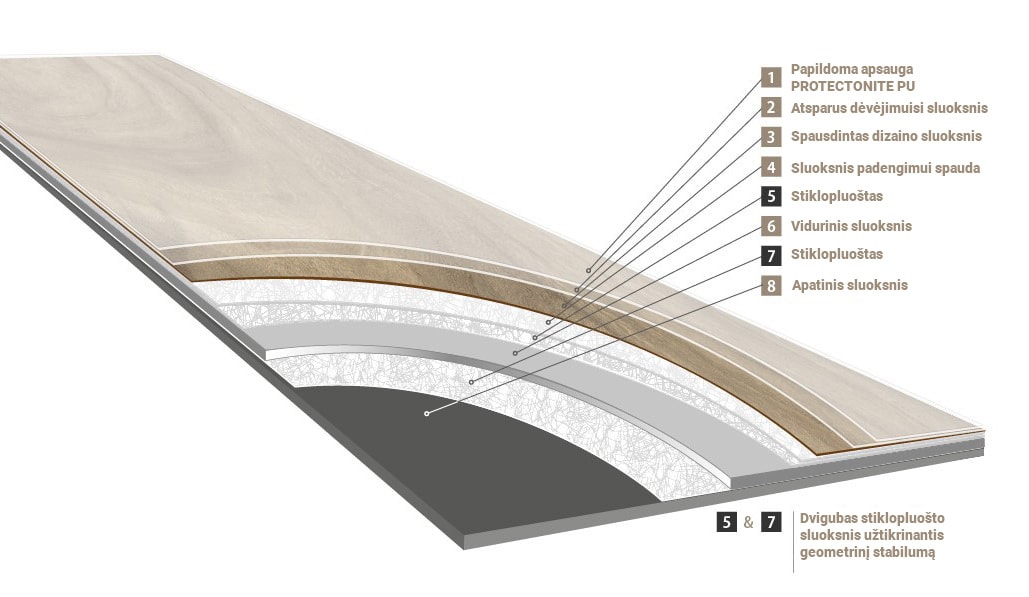
Vinyl plank construction: wear layer on top, decorative layer below it and a polymer PVC core
This is also where the confusing terminology comes from: “vinyl laminate” is a vinyl plank that looks similar to a laminate board and can use the same type of locking connection. It is not actually laminate.
Comparison table
| Vinyl flooring | Laminate | |
|---|---|---|
| Core | PVC (polymer) | HDF (wood fibreboard) |
| Water | water-resistant, suitable for bathrooms and kitchens | can swell and is unsuitable for wet areas |
| Thickness | 2–6 mm | usually 7–12 mm |
| Footstep noise | quieter, softer | more hollow-sounding, requires a good underlay |
| Underfloor heating | yes, up to +27 °C | not all collections |
| Local repair | glue-down flooring allows individual planks to be replaced | usually requires dismantling the floor up to the damaged area |
| Price at Openini | from €30/m² | not sold |
| Feel underfoot | warmer, slightly softer | harder |
Where vinyl clearly wins
Wet areas. Kitchens, entrance halls, bathrooms and homes with a dog that comes in wet from outside — laminate loses here not because of wear resistance, but because a single spill reaching a joint can become a problem.
Underfloor heating. 548 products in the catalogue are suitable for installation over underfloor heating. The standard limitation is a maximum surface temperature of +27 °C. A thin polymer plank transfers heat better than a thicker wood fibreboard.
Quietness. A 2.5 mm glue-down vinyl floor produces very little footstep noise. This is especially noticeable in apartments with neighbours below or in a child’s room.
Threshold height. When renovating without removing the existing flooring, the difference between 2.5 mm and 8–10 mm can sometimes be decisive.
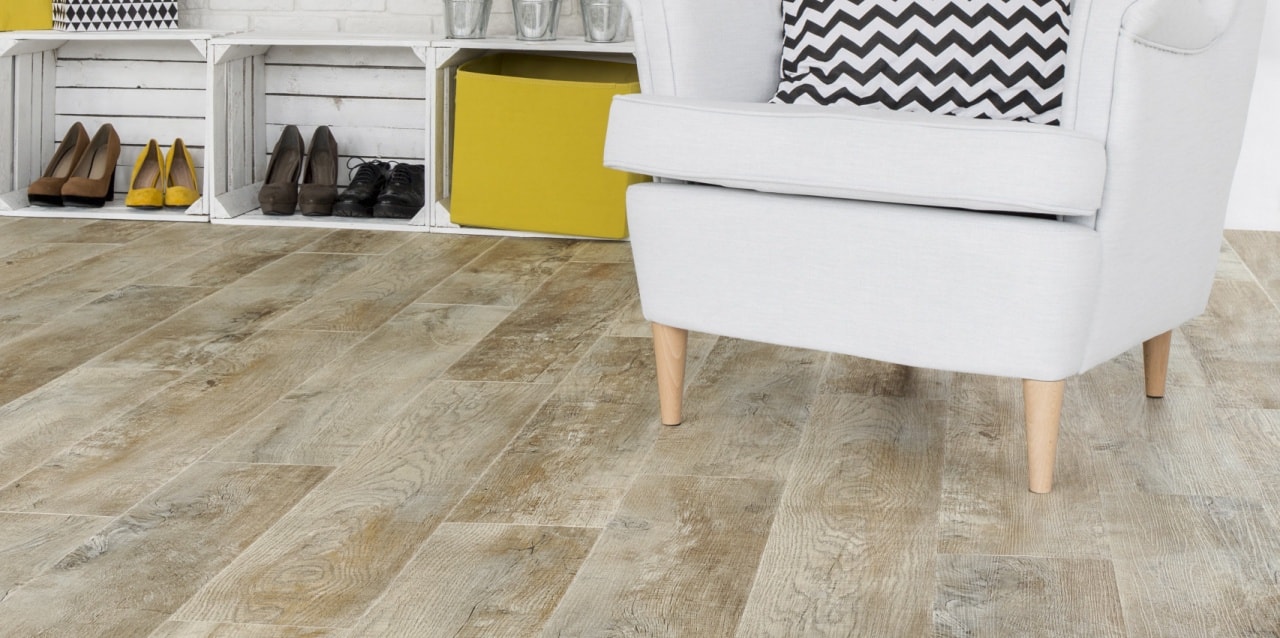
Vinyl flooring suits both wet areas and living spaces
Where laminate is not such a bad option
To be fair, in a dry bedroom or living room with no risk of water spills and no underfloor heating, good-quality laminate can last a long time and cost less. It feels harder underfoot, which some people prefer to the slightly resilient feel of vinyl. It also does not have the “plastic” feeling underfoot that some buyers dislike in vinyl flooring.
We do not sell laminate, not because laminate is bad, but because in our segment — wet areas, underfloor heating and commercial projects — vinyl generally solves the task better.
Two types of vinyl: flexible and rigid
There is also an important choice within vinyl flooring itself, and in many cases this matters more than the comparison with laminate.
Flexible LVT, 337 products. Thin, 2–2.5 mm, and glued to the subfloor across the entire surface. It is the quietest and one of the most durable options, but requires a perfectly level subfloor and professional installation.
Rigid SPC, 210 products. Thicker, 4–6 mm, with a Click locking system, installed as a floating floor without adhesive. It tolerates small subfloor imperfections better, is faster to install and usually costs less in labour.
For a detailed comparison, see LVT or SPC: how do vinyl floors differ?
What to look at instead of overall thickness
The overall plank thickness tells you more about rigidity than wear resistance. Service life is primarily determined by the protective wear layer above the decorative surface:
- 0.3 mm — suitable mainly for bedrooms; we have 9 such products
- 0.55 mm — the practical standard, 393 products out of 505
- 0.7 mm and above — for shops, offices and clinics, 35 products
The wear class is directly related to this: the catalogue includes 445 products in class 33 and 60 products in class 34. For an explanation of these ratings, see Vinyl flooring: class 32, 33 or 34.
How much does it cost?
Vinyl flooring at Openini ranges from €30 to €84/m² including VAT (discounts of up to 15% for larger quantities):
- LALEGNO — from €30/m², the most affordable entry point
- ARBITON — €32–52/m²
- MODULEO — €33–55/m², the widest selection (257 models)
- Dickson — €83–84/m², woven vinyl for commercial projects
In addition to the material itself, you should allow for subfloor preparation, adhesive or underlay, and installation labour. Manufacturer warranties: 25 years for 236 products and 20 years for 156 products.
What matters more than choosing between vinyl and laminate
The subfloor. Thin glue-down vinyl follows every imperfection in the floor — even a 2 mm bump may still be visible a year later. The requirement is the same as for parquet: deviation should not exceed 2 mm over 2 metres, and the screed moisture level must remain within the manufacturer’s permitted limits. More details are available in Pagrindo paruošimas grindų dangos klojimui (in Lithuanian).
If the subfloor is uneven and there is no budget for levelling, choose rigid SPC with a locking system, as it tolerates minor imperfections better.
What next?
See the flooring in person: all vinyl flooring from €30/m², rigid SPC with a locking system, flexible glue-down LVT, in-stock products with delivery in 1–3 days.
Samples are available in our showroom at T. Ševčenkos g. 19 in Vilnius — the difference between flexible and rigid vinyl is best understood by seeing and feeling both in person. Send us your room plan or floor area and within 24 hours we will suggest 2–3 options based on your budget and expected level of use.
FAQ
What is “vinyl laminate”?
It is an informal name for a vinyl plank with a locking connection. It looks and is assembled similarly to laminate, but its core is polymer-based rather than wood-based. It is not actually laminate.
Which is better for a kitchen — vinyl or laminate?
Vinyl. Laminate has a wood fibreboard core that can swell when exposed to water. All 505 vinyl flooring products in our catalogue are marked as 100% moisture-resistant.
Can vinyl flooring be installed over underfloor heating?
Yes. 548 products in the catalogue are approved for this use. The limitation is that the surface temperature must not exceed +27 °C. With laminate, not all collections are suitable for underfloor heating.
Which is quieter — vinyl or laminate?
Vinyl. The polymer plank absorbs footstep noise better, while laminate with an HDF core tends to sound more hollow and depends more heavily on the quality of the underlay.
Which vinyl flooring should I choose if the floor is uneven?
Rigid SPC with a Click locking system (210 products). It is thicker, 4–6 mm, and tolerates minor unevenness better. Flexible glue-down LVT requires a subfloor with no more than 2 mm deviation over 2 metres.
Read also: Vinyl flooring reviews: the common complaints and how to avoid them.